The Top 8 OSINT Tools, Platforms, and Techniques Dominating the Investigative Landscape Today
A 2026 field guide to the platforms moving the needle for cyber analysts, journalists, and investigators, and why “open source” doesn’t…

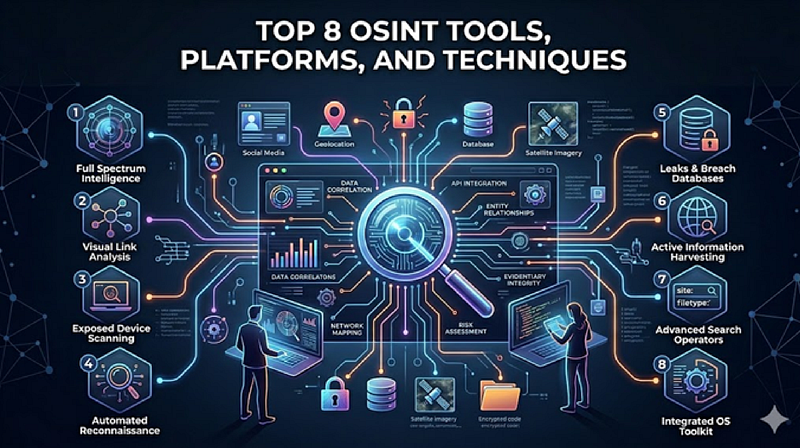
A 2026 field guide to the platforms moving the needle for cyber analysts, journalists, and investigators, and why “open source” doesn’t always mean what you think it means.
Every selfie geotag, leaked database, exposed S3 bucket, and forgotten LinkedIn endorsement is a breadcrumb. Multiply that by a few billion users, and add the dark web, blockchains, and messenger leaks on top, and you’ve got the modern investigator’s playground.
But raw breadcrumbs don’t solve cases. Tools do.
Here’s a tour through what OSINT really is, the misconception that trips up almost every beginner, and the eight platforms or technique doing the heaviest lifting in investigations today. At least for me.
Note: Yes, there are many other tools, platforms, and techniques, I can not name them all, I picked 8 that I mostly use, your milage may vary.
What Is OSINT, Really?
OSINT (Open Source Intelligence), is the discipline of collecting, correlating, and analyzing information that is publicly available to produce actionable insight.
That sounds dry, but the practical reality is anything but. OSINT is how a journalist in Manila traces a shell company back to its real owners in Cyprus. It’s how a SOC analyst maps a phishing infrastructure across forty domains before breakfast. It’s how a missing-persons investigator finds a runaway teen through a recycled Discord username.
The people leaning on OSINT every day include:
- Cyber threat intelligence analysts profiling threat actors and infrastructure
- Law enforcement and intelligence agencies building cases and tracking suspects
- Journalists and fact-checkers verifying claims, sources, and documents
- Private investigators and corporate due-diligence teams vetting partners, hires, and acquisitions
- Fraud and AML/KYC specialists in banks and fintechs
- Penetration testers and red teamers doing reconnaissance before an engagement
- Human-rights researchers and conflict monitors documenting atrocities from open footage
If the data exists in public, a tweet, a domain registration, a leaked credential dump, a satellite image, a court filing, OSINT is the craft of turning it into intelligence.
The “Open Source” Misconception — Read This Before You Argue On Reddit
Here’s the myth that refuses to die:
“If it’s Open Source Intelligence, all the tools should be free and open-source software, right?”
Wrong. And this misunderstanding has burned more aspiring analysts than any other.
In OSINT, “open source” refers to the data, not the software. It’s borrowed from the intelligence community’s classic taxonomy, HUMINT (human sources), SIGINT (signals), GEOINT (geospatial), IMINT (imagery), and OSINT (open, publicly accessible sources). The label describes where the information comes from, not the license on your tooling.
A scraper written in Python that pulls public Telegram channels and translates them like the one I wrote? OSINT. A six-figure-a-year SaaS platform that aggregates the same data and visualizes it on a graph? Also OSINT.
A good time to link to the tool I wrote for telegram and that you can use freely :D
Why Paid and Commercial OSINT Tools Are Indispensable in 2026
Free and open-source tools are wonderful, and you’ll still see veterans firing up theHarvester, Recon-ng, or a stack of bash one-liners. But for serious, repeatable, investigation-grade work, commercial platforms have become non-negotiable for several reasons:
- Scale. A single investigator manually scrolling LinkedIn or Telegram can do hours of work in an afternoon. A commercial platform can process millions of data points before your coffee cools.
- API integrations. Reliable, maintained access to social platforms, breach databases, blockchain explorers, and dark-web mirrors — without your scraper getting banned every Tuesday.
- Visualization. Link-analysis graphs that turn a haystack of usernames, wallet addresses, and IPs into a readable network of relationships.
- Automation and workflow. Reusable templates, scripted pivots, monitoring, alerting, and team collaboration features.
- Evidentiary integrity. Audit logs, hash-stamped exports, and reporting structures that hold up in court or in a board room.
- Legal coverage and data partnerships. Vendors negotiate data-sharing agreements, terms of service, and compliance frameworks so investigators don’t have to.
A free script can answer a question. A commercial platform answers a case. Both have a place — but pretending the paid tier is somehow “not real OSINT” is amateur hour.
Now, the list.
The Top 8 OSINT Tools / tecniques / Platforms Dominating Investigations Today
1. Social Links: The Heavyweight Built for the Full Investigation Lifecycle
Pricing: Paid (enterprise / professional tiers, with a Maltego-extension option) Best for: End-to-end investigations across social media, messengers, blockchain, and the dark web.
If you ask working investigators in law enforcement, cyber-intel, and corporate security what platform has reshaped their workflow in the last few years, Social Links comes up again and again, and for good reason.
Social Links isn’t just a scraper or a single-source aggregator. It’s a full-spectrum investigative platform that ties together 500+ open data sources spanning social media, messaging apps, blockchains, the surface web, and the dark web, and then pours all of it into a graph-driven workspace where connections actually become visible.
Their flagship investigative platform, SL Crimewall, was purpose-built to compress the entire intelligence cycle, extraction, enrichment, visualization, analysis, and reporting, into a single interface. For analysts already entrenched in Maltego or i2, SL Professional plugs the same data engine into those environments.
What makes it stand out:
- Breadth of sources that most competitors can’t touch, including hard-to-reach platforms, niche regional networks, blockchains, and dark-web forums
- AI-assisted link analysis that surfaces non-obvious relationships across digital identities
- No-code script builder for analysts who don’t speak Python, plus a full Script Builder for those who do
- Collaborative workspaces with audit trails, shared graphs, and access controls, built for case work, not for solo dabbling
- Real-world use in law enforcement, financial crime, AML/KYC, due diligence, and threat intelligence across dozens of countries
Stay tuned. I’m going to be featuring Social Links in extensive detail very soon, with hands-on, end-to-end sample investigation write-ups that walk through real OSINT scenarios from a single suspicious username to a fully mapped criminal network. If you’ve ever wanted to see what a platform like this can actually do beyond the marketing gloss, hit follow now so you don’t miss those deep-dives.
2. Maltego: The Granddaddy of Link Analysis
Pricing: Freemium (Community Edition free, with paid Pro, Enterprise, and Transform Hub add-ons) Best for: Visual link analysis, entity mapping, and connecting disparate data points
If OSINT had a Mount Rushmore, Maltego’s face would be on it. For years, it has been the canonical graph-based investigation tool, pulling entities (people, emails, domains, phone numbers, IPs, social handles) onto a canvas and revealing the relationships between them through “Transforms” that query external data sources.
Where Maltego shines:
- The Transform Hub ecosystem, hundreds of data integrations from vendors like Social Links, IntelX, Shodan, Have I Been Pwned, and more
- Beautiful, court-presentable graph visualizations that turn complex investigations into a story a non-technical audience can follow
- A free Community Edition that’s surprisingly capable for learners
The catch? Maltego is a canvas, not a data source. Its power depends on the Transforms you plug into it, most of the really juicy ones cost money. Think of it as Photoshop for investigators: the software is one purchase, but the brushes (data) are where the budget goes.
3. Shodan: The Search Engine for the Internet of (Exposed) Things
Pricing: Freemium (free tier with limits; affordable lifetime “membership” deals and enterprise tiers) Best for: Discovering exposed devices, services, infrastructure reconnaissance, and attack-surface mapping
While Google indexes web pages, Shodan indexes everything else, the servers, webcams, industrial control systems, routers, databases, and IoT devices quietly humming away on the public internet.
Type in a query and you can find:
- Every Elasticsearch instance exposed without authentication in a given country
- Industrial SCADA systems begging to be hardened
- Default-credentialed webcams (yes, still, in 2026)
- A target organization’s entire externally-facing footprint
For red teamers, threat hunters, and corporate security teams doing attack-surface management, Shodan is non-negotiable. It’s the tool that reminds everyone, painfully, that the internet remembers everything you accidentally exposed.
4. SpiderFoot: Automated Reconnaissance on Autopilot
Pricing: Free, open source (with the original commercial HX tier now absorbed into Intel 471’s enterprise platform) Best for: Automated, hands-off reconnaissance over a target domain, IP, person, or organization.
Hand SpiderFoot a target, a domain, an email, a name, an IP, a phone number, and it will quietly knock on the doors of 200+ data sources on your behalf, returning a structured profile of everything publicly knowable.
It’s the tool you fire up while you go make coffee. Subdomains, leaked credentials, exposed services, related accounts, dark-web mentions, all pulled, correlated, and waiting for you when you get back.
A quick note on the state of the project, because it matters:
In November 2022, Intel 471 acquired SpiderFoot, and founder Steve Micallef joined them as VP of Attack Surface Technology. Since the acquisition:
- The open-source SpiderFoot (last major release: v4.0, April 2022) is still freely available on GitHub and ships pre-installed on Kali, CSI Linux, and most investigator distros. It still works. It’s just not actively developed anymore.
- SpiderFoot HX: the former hosted commercial tier has been folded into Intel 471’s TITAN platform and is now sold as part of their enterprise Attack Surface Protection offering, rather than as a standalone freemium SaaS.
So when someone says “I use SpiderFoot” in 2026, they almost always mean the open-source version, which is still a brilliant introduction to automated OSINT, still a great learning tool, and still genuinely useful for one-shot scans. Just don’t expect new modules or major features going forward.
Worth knowing: “OSINT Industries,” “Maigret,” and similar projects often get name-checked alongside SpiderFoot in the automated-recon category — all worth a look depending on your use case, especially if you want something more actively maintained.
5. Intelligence X (IntelX): The Search Engine of Leaks, Pastes, and the Forgotten Web

Pricing: Freemium (limited free searches; paid tiers for serious use) Best for: Searching the dark web, data leaks, paste sites, document archives, and historical records
Intelligence X is what you reach for when Google can’t help, because Google doesn’t index breach dumps, Tor hidden services, paste sites, public document leaks, or the layers of “gray web” content that often hold the answer to an investigation.
Search for an email, a domain, a Bitcoin address, a phone number, or even a snippet of text, and IntelX will tell you where it has appeared across:
- Major and minor data breaches
- Pastebin and similar paste sites (current and historical)
- Tor and I2P hidden services
- Public document archives (court records, government leaks, etc.)
- Historical snapshots that have since been deleted from the surface web
It is, to put it plainly, the closest thing OSINT has to a time machine for the internet.
6. theHarvester: The Command-Line Classic That Still Earns Its Spot

Pricing: Free (open source; pre-installed on Kali Linux) Best for: Early-stage reconnaissance, harvesting emails, subdomains, hosts, employee names, and IPs tied to a target domain or organization.
Walk into any pen-test team, red-team engagement, or bug-bounty session and you’ll find theHarvester running somewhere. It’s been around for over a decade, it’s still actively maintained, and it remains one of the cleanest examples of what an OSINT tool is: a single, focused utility that takes a target and returns publicly available intelligence about it, fast.
Point it at a domain like targetcompany.com and theHarvester will scrape dozens of passive data sources to return:
- Email addresses tied to the domain
- Subdomains and hostnames
- Employee names (often via LinkedIn-adjacent sources)
- IP addresses and netblocks
- URLs and virtual hosts
- Certificate transparency log entries
It pulls from search engines (Google, Bing, DuckDuckGo, Baidu), certificate transparency logs (crt.sh), PGP key servers, Shodan, Hunter.io, VirusTotal, and a long list of others , all from one command line.
Why it still matters in 2026:
- It does one thing exceptionally well: passive recon — and doesn’t pretend to be a platform
- It’s free, open source, and scriptable, drop it into a pipeline, a CI job, or a Bash loop without licensing headaches
- It’s a phenomenal learning tool, running theHarvester teaches you what passive OSINT collection actually looks like under the hood, before you start paying for platforms that abstract it all away
The fancy commercial tools above will run circles around it on scale and visualization. But for the first 10 minutes of an investigation — when you just need to know what’s out there — theHarvester is still the right answer.
7. Google Dorking: The Free, Foundational Skill Every Investigator Needs
Pricing: Free (it’s literally just Google. And Bing. And DuckDuckGo.) Best for: Targeted searches, exposed documents, misconfigured servers, and finding things that technically shouldn’t be findable
“Wait — isn’t Google Dorking a technique, not a tool?”
Fair challenge. I’m including it anyway, and here’s why: every search engine is a tool, and the dork syntax is the interface through which investigators actually use it. If we disqualified Google Dorking on technicality, we’d also have to throw out Maltego Transforms (a technique), regex (a technique), and most of what makes any of these platforms useful. The unit that matters in an investigator’s workflow is the practical capability, not the .exe. And in 2026, the ability to weaponize a public search engine with operator syntax remains one of the highest-leverage capabilities in OSINT, full stop. Leaving it off a top-7 list would be cosmetically tidy and operationally dishonest.
You don’t need a $50,000/year platform to find an internal HR spreadsheet someone accidentally indexed. You need Google Dorking, the practice of using advanced search operators to surgically extract information from public search engines.
A few classics every investigator should know:
site:restrict to a domainintitle:andinurl:match page titles and URLsfiletype:find specific document types (pdf,xls,docx,sql...)intext:match page contentcache:view historical versions- Combined:
site:targetcompany.com filetype:pdf intext:"confidential"
Whole investigations have started, and ended, with a single well-crafted dork. Resources like the Google Hacking Database (GHDB) maintained by Exploit-DB catalog thousands of proven query patterns.
It’s free. It’s foundational. And if you can’t dork, you can’t OSINT.
8. CSI Linux: The Entire Investigator’s Toolkit, Pre-Installed

The team around Jeremy Martin has put this together, and it is awesome. I have seperate articules on it.
Pricing: Free (Free to download in many different formats; paid courses and certifications are offered as well ) Best for: Running an entire investigation from a single, purpose-built operating system — without spending a week installing tools
Every tool on this list so far solves a piece of the puzzle. CSI Linux is the bench you put them all on.
CSI Linux is a Debian/Ubuntu-based investigation-focused Linux distribution built specifically for OSINT, digital forensics, incident response, and dark-web work. Where Kali Linux is built for offensive security, CSI Linux is built for investigators, and the tooling reflects it.
Out of the box, a CSI Linux install gives you:
- OSINT tools: Maltego, SpiderFoot, theHarvester, Recon-ng, Sherlock, ExifTool, and dozens more, pre-installed and pre-configured
- Dark-web access: hardened Tor, I2P, and onion-service workflows ready to go without the usual operational-security footguns
- Social media investigation utilities for username pivoting, profile analysis, and metadata extraction
- Digital forensics: Autopsy, Sleuth Kit, Volatility for memory analysis, and full disk-imaging workflows
- Case management: built-in tooling to organize evidence, maintain chain of custody, and produce court-ready reports
- Cryptocurrency tracing: utilities for blockchain investigations
- Geolocation, image analysis, and timeline-reconstruction kits
Why it earns the final spot:
- Time savings are massive. Spinning up an investigator’s workstation from scratch, installing tools, resolving dependency conflicts, configuring Tor properly, setting up case folders, easily eats a week. CSI Linux compresses that into a single download.
- Operational security is baked in. The distro is configured with investigator OPSEC defaults from the start, not bolted on as an afterthought.
- Reproducibility. Run the same VM on every case and your environment, tool versions, and output formats stay consistent, which matters enormously when your findings need to hold up in court or in front of a review board.
- It’s a force multiplier for everything else on this list. theHarvester, SpiderFoot, Maltego CE, Google Dorking workflows, they all live happily inside CSI Linux, often pre-configured with sensible defaults.
The VM is free and there’s a full certification track (CSI Linux Certified Investigator, etc.) for those building a formal career around it.
If the other seven entries are individual instruments, CSI Linux is the orchestra pit.
15 More Tools Worth Bookmarking
The list above is the headline act, but no serious investigator’s toolkit stops at eight. Here are 15 more OSINT tools, platforms, and resources worth knowing, bookmark them, try them, and let me know which ones deserve their own deep-dive next:
Infrastructure & network recon
People, accounts & social
Images, metadata & geolocation
Web history & archives
Frameworks, aggregators & investigative platforms
Where Digital Investigations Go From Here
The investigative landscape is shifting fast. AI-powered link analysis is becoming standard, not premium. Blockchain forensics has gone from niche specialty to baseline skill. Deepfake detection and synthetic-content verification are now part of the OSINT toolkit. And the line between “open source” and “everything else” keeps blurring as more of our lives leak into the public layer of the internet.
The investigators winning in 2026 aren’t the ones with the longest tool list. They’re the ones who understand what each tool is actually for, when to escalate from a free dork to a paid platform, and how to weave findings into a story that stands up to scrutiny.
If this walkthrough was useful, clap, comment, and follow.
Next up: a full end-to-end Social Links investigation walkthrough, real scenario, real workflow, real findings, from a single dangling clue to a fully mapped network. You won’t want to miss it.
What tool do you swear by that didn’t make this list? Drop it in the comments, best one gets a feature in an upcoming post.
Reach out if you have questions or comments or what to collaborate
Session Messenger: 059db238ab37c3d92615c5cc24b694da29c598cc13e27886053722404118e14271