The Invisible Backbone of Modern OSINT: Why Residential Proxies Are Non-Negotiable for Serious…
An in-depth look at how residential IP infrastructure has quietly become the single most important OPSEC layer for threat intelligence…

The Invisible Backbone of Modern OSINT: Why Residential Proxies Are Non-Negotiable for Serious Investigators
An in-depth look at how residential IP infrastructure has quietly become the single most important OPSEC layer for threat intelligence analysts, brand protection teams, and open-source investigators featuring a hands-on walkthrough with Decodo (formerly Smartproxy).
A word before going further. This article is written for security researchers, threat intelligence analysts, journalists, brand protection teams, and other practitioners conducting legitimate, lawful investigations. The techniques described here are not a license to violate platform terms of service, breach computer access laws, harass individuals, or evade legitimate authorities, that misuse is on whoever commits it, and nothing in this piece endorses it. Equally important: a residential proxy is not an invisibility cloak. It changes the IP your traffic appears to come from, and nothing else. Browser fingerprints, cookies, behavioral timing, account artifacts, TLS signatures, and dozens of other signals can still identify you. Real operational anonymity is a layered discipline; a proxy is one layer of it. Treat it as the whole solution and you will eventually be identified.
Introduction: Demystifying Residential Proxies
In the OSINT community, there is a growing understanding that the quality of your data is directly proportional to the quality of the infrastructure you collect it from. And no piece of infrastructure has become more central to that equation than the residential proxy.
A residential proxy is an intermediary server that routes your internet traffic through a real consumer device, a home laptop, a smart TV, a mobile phone, whose IP address has been legitimately assigned by a residential Internet Service Provider (ISP) like Comcast, BT, Telekom Austria, or PLDT. To the target server, your request looks indistinguishable from a person browsing on their home Wi-Fi in a suburb of Manila, Vienna, or Atlanta.
This is fundamentally different from the more common datacenter proxy, which routes traffic through IPs hosted on commercial cloud infrastructure, AWS, Google Cloud, OVH, Hetzner, DigitalOcean, and the like. Datacenter IPs are:
- Easy to identify. They sit in well-known Autonomous System Numbers (ASNs) that any security vendor can fingerprint with a single lookup.
- Frequently shared. Thousands of scrapers, bots, and abusers have already burned these ranges, meaning they often arrive at a target site pre-flagged.
- Geographically generic. A “US datacenter IP” rarely maps to a believable consumer location.
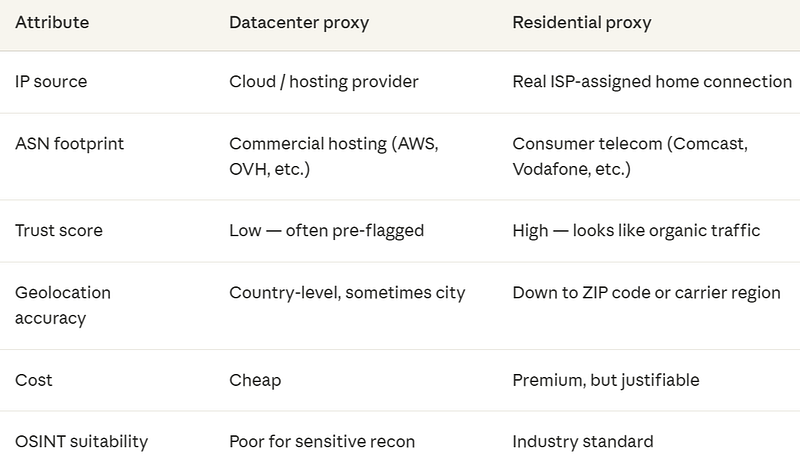
For an OSINT investigator, the choice is rarely about price, it’s about attribution avoidance. The whole point of open-source intelligence is that the target should never know they were the subject of inquiry. A datacenter IP carrying a Python requests user-agent signature is, in 2026, roughly the digital equivalent of conducting a stakeout in a clearly marked van.
Residential proxies dissolve that visibility problem. They are the foundation on which serious anonymity, access, and data fidelity are built.
2. Why Residential Proxies Are an Absolute “Must” for OSINT
The OPSEC Rule: You Cannot Investigate What Knows You Are Watching
Operational security in OSINT comes down to one principle: the target’s behavior must not change because of your investigation. The moment a threat actor, a counterfeit seller, or a disinformation network realizes they are under observation, three things happen, and all of them are catastrophic for the investigator:
- Evidence destruction. Sites get taken offline, infrastructure gets rotated, accounts get scrubbed, and Telegram channels evaporate.
- Counter-intelligence injection. Sophisticated targets serve poisoned content, fake prices, fabricated user data, deliberately misleading forum posts, to traffic they suspect is investigative.
- Attribution back to you. Worst of all, your organization’s IP range, ASN, or even physical office location can be reverse-correlated, exposing analysts to retaliation, lawsuits, or operational compromise.
This is why residential proxies are not a “nice to have.” They are the difference between collecting genuine intelligence and collecting whatever the adversary wanted you to see.
How Modern Anti-Bot Stacks Defeat Datacenter Traffic
The websites OSINT investigators care about most, social platforms, marketplaces, forums, news sites, and threat actor properties, are precisely the sites with the most aggressive defensive infrastructure. The leading vendors in this space (Cloudflare Bot Management, Akamai Bot Manager, DataDome, PerimeterX/HUMAN, Imperva) all use multi-signal detection that includes:
- ASN reputation scoring. Traffic from known hosting ASNs is automatically de-prioritized or blocked. AWS IPs alone account for a measurable fraction of all bot traffic globally; defenders know this.
- IP rate-limiting. Even if your datacenter IP is initially trusted, hitting more than a few dozen requests per minute will trigger throttling, CAPTCHA walls, or outright bans.
- Geo-fencing. Many threat-relevant resources (regional phishing kits, country-specific scam sites, localized propaganda) are only served to visitors whose IP geolocates to the intended victim region. A US datacenter IP querying a Vietnamese phishing page will be redirected to a benign decoy.
- Counter-intelligence serving. This is the most insidious tactic. Rather than block suspicious traffic, sophisticated operators serve it altered content. Investigators studying cryptocurrency scam pages, for example, have documented different pricing, different wallet addresses, and even different victim narratives being shown depending on the visitor’s IP reputation. The investigator walks away with bad data and doesn’t know it.
Residential proxies neutralize all four of these defensive layers simultaneously. Because the IP belongs to a real consumer device on a real ISP, it has organic reputation. Because the pool rotates across millions of endpoints, rate-limiting becomes nearly impossible to enforce. Because the IP geolocates to a genuine residential block, geo-fenced content is served correctly. And because nothing about the request signature flags as “investigative,” counter-intelligence payloads are not triggered.
In short: residential proxies don’t just hide you, they make the target behave authentically in your presence. That’s the whole game.
3. Common OSINT Use Cases for Residential Proxies
3.1 Social Media Intelligence (SOCMINT)
Platforms like Instagram, TikTok, X, LinkedIn, Facebook, and Reddit have invested heavily in detecting non-human or non-residential traffic. Their motivation is partly commercial (preventing competitive scraping) and partly safety-driven (combating coordinated inauthentic behavior). The side effect is that legitimate OSINT collection is treated with the same hostility as malicious botting.
A SOCMINT analyst tracking a target’s public profile, a network of suspected sock-puppet accounts, or an emerging influence operation needs to:
- View profiles at scale without triggering “unusual activity detected” challenges.
- Maintain sock-puppet research accounts that don’t get instantly banned because they log in from a datacenter IP.
- Collect historical post data without exceeding per-IP rate limits.
- Cross-reference followers, likes, and comment graphs — workflows that can require thousands of authenticated API or web requests.
Residential proxies allow analysts to distribute this traffic across thousands of believable consumer IPs, with sticky sessions for account-bound work (where the same IP must persist for an entire login session) and rotating sessions for high-volume reconnaissance.
3.2 Localized Threat Intelligence and Geo-Targeting
Threat actors have learned a critical lesson: be invisible to anyone who isn’t your target. Modern phishing kits, scam infrastructure, and regional disinformation operations routinely employ aggressive geo-fencing, a malicious page may only render its true payload to visitors from a single country, sometimes a single ISP or city.
Consider these realistic scenarios:
- A banking trojan landing page that only delivers its malware to IPs geolocating to Brazil, serving an innocuous redirect to everyone else.
- A localized disinformation campaign running ads visible only to users in three swing states during an election cycle.
- A regional underground forum that returns a 403 to any visitor outside Eastern Europe.
Residential proxies with city-level and ZIP-code-level targeting let an investigator pivot their apparent location instantly, appearing as a São Paulo home connection one minute and a Warsaw mobile carrier IP the next. This is the only viable way to study geo-fenced threats with high fidelity.
3.3 Corporate Auditing and Brand Protection
For corporate security, legal, and trust-and-safety teams, residential proxies have become essential to anti-counterfeiting and anti-fraud operations. The reason is obvious once you’ve seen it: adversaries blocklist corporate IP ranges.
A counterfeiter selling fake luxury goods on a third-party marketplace knows perfectly well that the legitimate brand’s investigators come from the brand’s corporate ASN. They block that ASN at the edge. They redirect to a “this listing is no longer available” page when they see Cloudflare data identifying corporate proxies. They show different prices, different stock photos, and different shipping policies to suspected investigative traffic.
The same dynamic plays out across:
- Phishing infrastructure that filters out the targeted bank’s known IP space.
- Intellectual property theft, pirated software portals, leaked-document marketplaces, that block traffic from media companies, law firms, and rights-holders.
- Grey-market e-commerce running parallel imports or unauthorized resellers who know to hide from manufacturer surveillance.
A brand protection analyst routing through residential proxies appears as just another consumer browsing, and sees what consumers see. That’s the only basis for credible evidence, takedown requests, and legal action.
3.4 Automated Web Scraping on Threat Forums and Underground Marketplaces
The threat intelligence community lives on data collected from places that don’t want analysts visiting: dark-web-adjacent forums, breach data marketplaces, ransomware leak sites, carding forums, exploit brokers, doxxing repositories, and extremist messaging channels accessible via the clear web.
These properties typically maintain their own blocklists — frequently sharing notes with each other, of:
- Known threat intel vendor IP ranges
- Tor exit nodes
- VPN endpoints
- Datacenter ASNs
- Anything resembling automated infrastructure
Worse, several of these forums actively monitor visitor patterns and manually investigate suspicious traffic, attempting to dox the analysts on the other end. A residential proxy pool with rotating exit nodes makes large-scale automated collection from these properties feasible without lighting up the operators’ counterintelligence radar.
Combined with proper request pacing, browser fingerprint randomization, and session management, residential proxies allow analysts to maintain persistent collection pipelines on hostile properties that would burn any other infrastructure in hours.
3.5 Ad Verification and Disinformation Mapping
A growing fifth use case, particularly relevant for election integrity researchers, journalists, and trust-and-safety teams, is ad verification. Programmatic ad platforms serve different creative to different demographics and geographies, and bad actors exploit this to run targeted disinformation, financial scams, or discriminatory housing/employment ads invisible to general audiences.
The only way to surface this kind of misconduct is to appear, repeatedly, as many different believable consumers. Residential proxies, rotated across demographic-relevant geographies and combined with realistic browsing patterns, are the foundation of every credible ad-transparency investigation.
4. Industry Spotlight: Decodo (Formerly Smartproxy)
For the sake of a demo, I chose Decodo, however, that does not mean it is the one best suited for you. I will share a few others at the end of the article and there are different reasons why each of them may be your best fit.
Among the residential proxy providers serving the OSINT and threat intelligence community, Decodo, the rebranded identity of the long-established Smartproxy,has become a recognizable name for several concrete, operationally relevant reasons:
- Scale. Decodo operates a pool of 115M+ ethically sourced residential IPs spanning every country and most major cities. For investigators working geo-fenced cases, this granularity is decisive.
- Performance. Average response times in the sub-second range, with documented success rates above industry norms on aggressively defended targets. For automated pipelines, this directly translates to throughput.
- Ethical sourcing. Decodo’s IP pool is sourced through consent-based SDK partnerships, not the opaque botnet-adjacent practices that have plagued parts of the proxy industry. For investigators concerned about evidentiary chain-of-custody (and the optics of using ethically grey infrastructure in legal proceedings), this matters.
- Session control. Both rotating (a new IP per request) and sticky (a stable IP for the duration of a session, typically up to 30 minutes) modes are first-class features, exposed cleanly through the API and dashboard.
- Targeting granularity. Country, state/region, city, and even ASN-level selection — essential for the localized threat intelligence work described above.
- A genuine free trial. Unlike many in the space, Decodo offers a no-strings trial that’s adequate for real proof-of-concept work, not just a token sample.
It is, in practical terms, infrastructure built with serious users in mind — and that’s where the next section comes in.
5. Hands-On Showcase: Leveraging the Decodo Free Trial
To demonstrate two distinct workflows every OSINT investigator should master, I’m spinning up Decodo’s free trial and exercising both of its primary integration surfaces: the programmatic API for automated collection, and the Firefox extension for live manual investigation.
These two modes — automation and stealth manual browsing — together cover virtually every OSINT scenario you’ll encounter.
Go to Decodo, get a free trial, good for 100 MB, enough to test it, and decide if it works for your need and workflow.
Use Case 1: The API Workflow: Automated Data Gathering at Scale
The first integration path uses Decodo’s Web Scraping API (and the underlying proxy endpoints) to feed automated OSINT scripts and orchestration platforms. This is where heavy-lift collection lives: continuous monitoring of dozens of threat forums, scheduled scrapes of marketplace listings, large-batch profile enrichment, and so on.
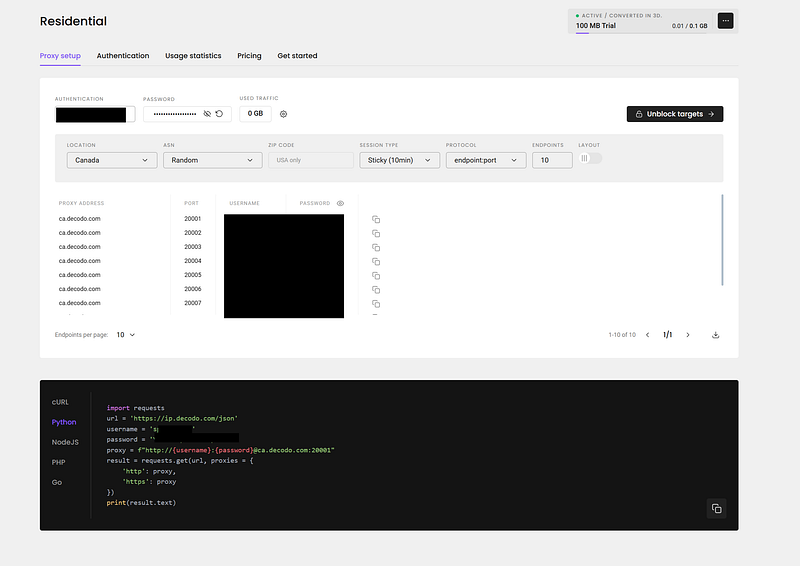
Note: you can get the username / password required for programatic access to the residential proxy as follows:
In the Decodo dashboard, go to the residential proxies section → proxy setup / authentication. You’ll see:
- A generated proxy username and proxy password (separate from your Google login)
- The endpoint hostname and port, copy these exactly as the dashboard shows them, since they may differ from the illustrative values in the article
The typical pattern looks like this: minimal Python, maximum signal:
import requests
url = 'https://ip.decodo.com/json'
username = 'username'
password = 'password'
proxy = f"http://{username}:{password}@gate.decodo.com:10001"
result = requests.get(url, proxies = {
    'http': proxy,
    'https': proxy
})
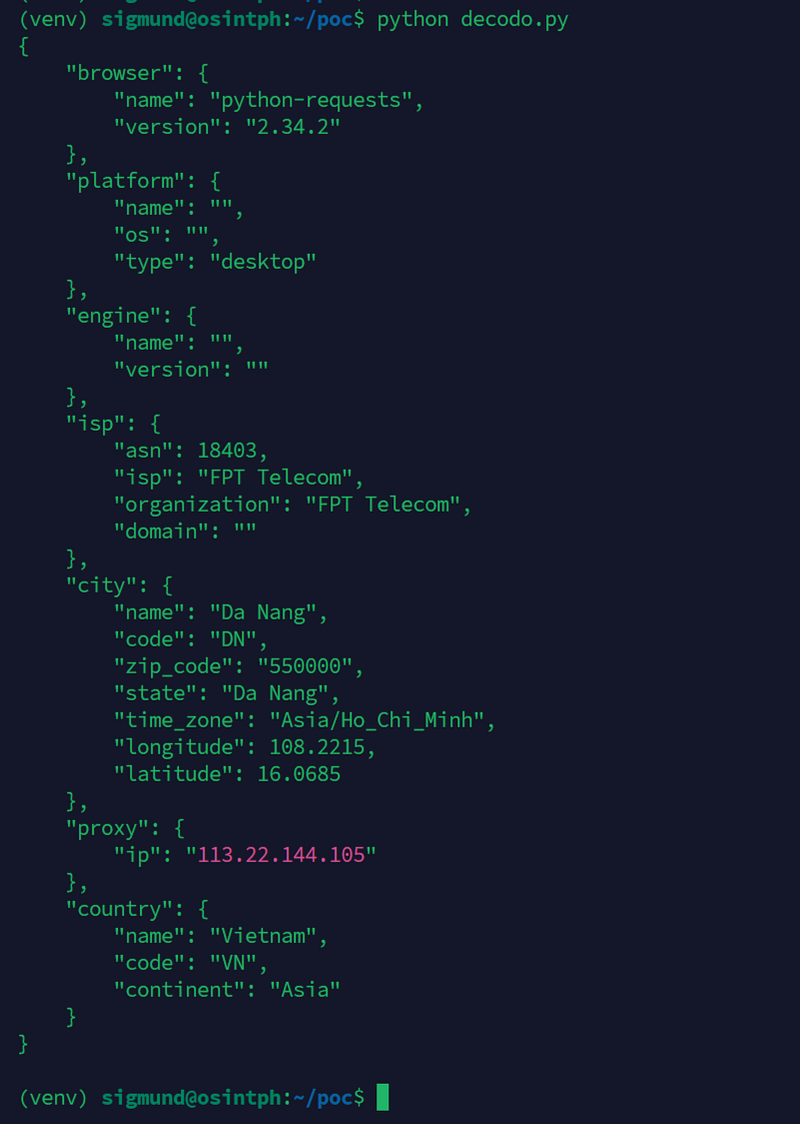
print(result.text)
If you run this script, the outcome will be similar to this:
Feel free to experiment with the different locations, chosing them will show which proxy and port to use in your script:
The outcome now is Canada:
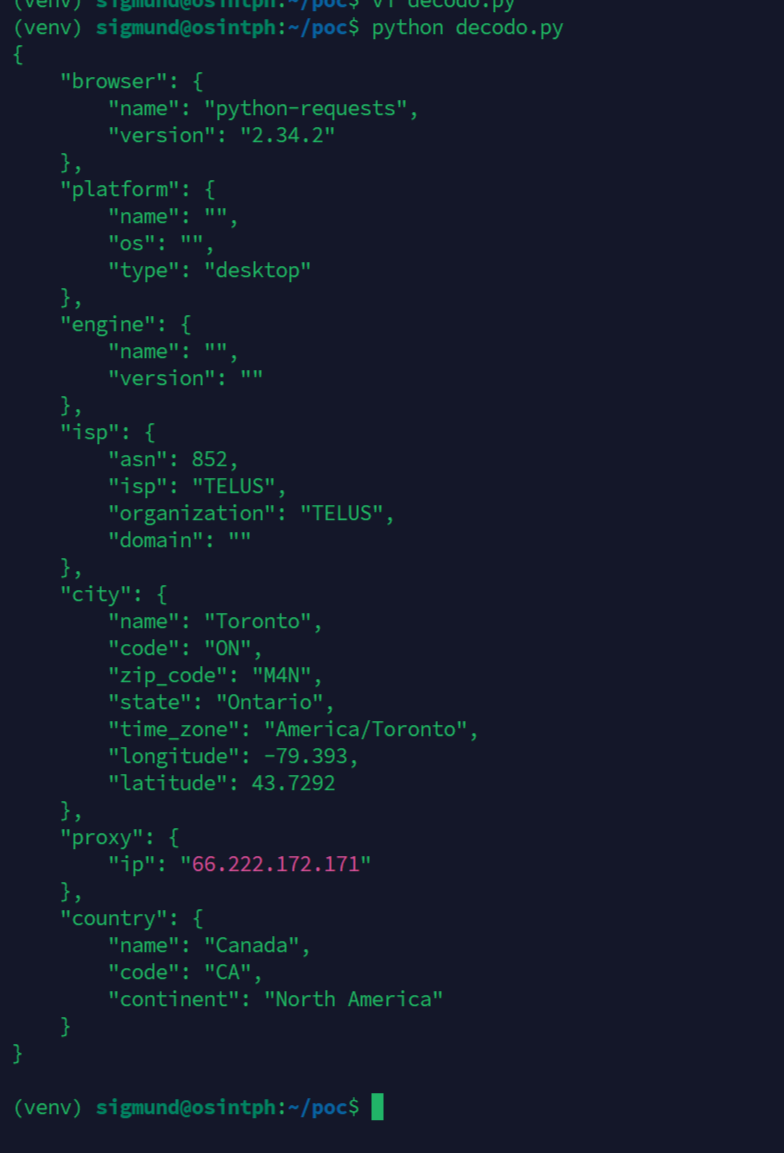
That’s it. A handful of lines and your traffic is now routing through a rotating residential IP pool. The JSON response that comes back will show the exit-node IP, city, and ISP your request just appeared from, not your own. Run it two or three times and you’ll watch the location shift between calls; that’s the rotation working. Once you’ve confirmed the plumbing, swap ip.decodo.com/json for any real target URL and the same script carries you straight into production collection, with each request arriving at the destination from a different home broadband connection somewhere in the world.
Where this gets genuinely powerful is when you compose it into larger pipelines:
- Workflow automation in n8n or Make. Trigger a scrape on a schedule, pipe results into a deduplication step, enrich entities via an LLM, store findings in a database, alert on changes via Slack. The proxy is just one node, invisible, reliable.
- Agent frameworks like LangChain or LlamaIndex. Investigative AI agents that browse on your behalf benefit enormously from residential egress. Without it, the agent’s tools immediately hit CAPTCHA walls and fail silently.
- CAPTCHA and JavaScript handling. Decodo’s higher-tier Web Scraping API endpoints handle CAPTCHA solving and headless browser rendering server-side, meaning your script gets clean parsed HTML back from JavaScript-heavy targets without you maintaining a Playwright fleet.
- High-volume public data collection. Sites that would rate-limit you after 50 requests from a single IP become tractable when each request egresses from a different residential connection.
For OSINT teams maintaining continuous collection pipelines — Telegram channel scrapers, marketplace monitors, news-site change-detectors , this API-driven approach is the spine of the operation.
Use Case 2: The Firefox Extension Workflow: Manual Stealth Investigation
Automation handles bulk. But the most consequential OSINT moments are often manual, an analyst clicking through a suspicious site, pivoting on a curious detail, following an instinct that no script would catch. For this work, the Decodo Firefox extension is the more elegant tool.
Search the marketplace for Decodo and install the extension, login with your account, initially you will see this:
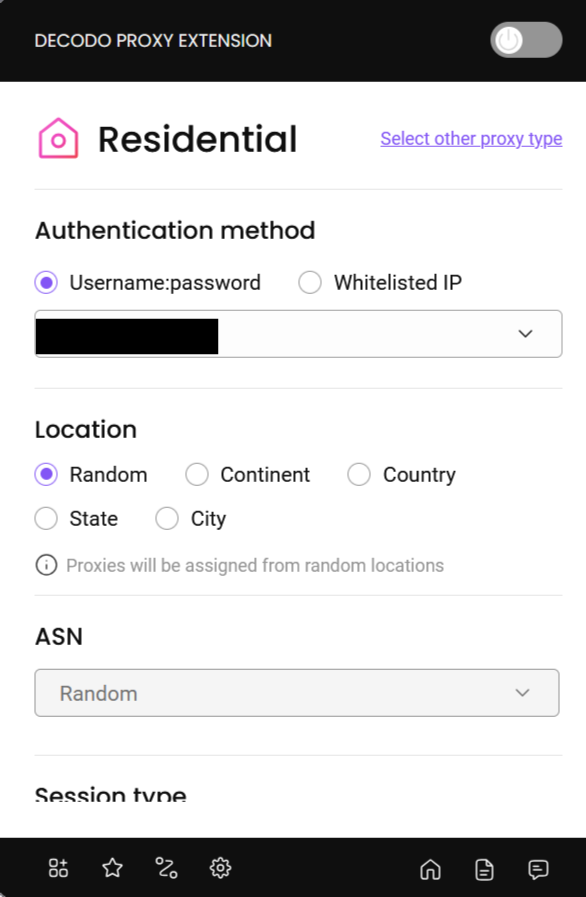
Once you have configured the Residental Proxy settings, turn it on:
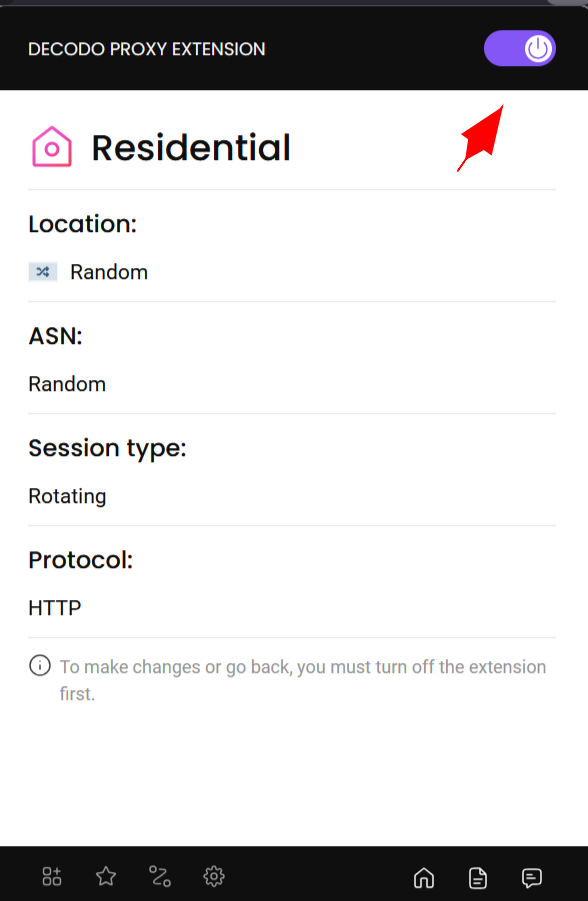
You will see that you get an IP from a random ISP, one that will not show as a VPN connection, Datacenter, os such.
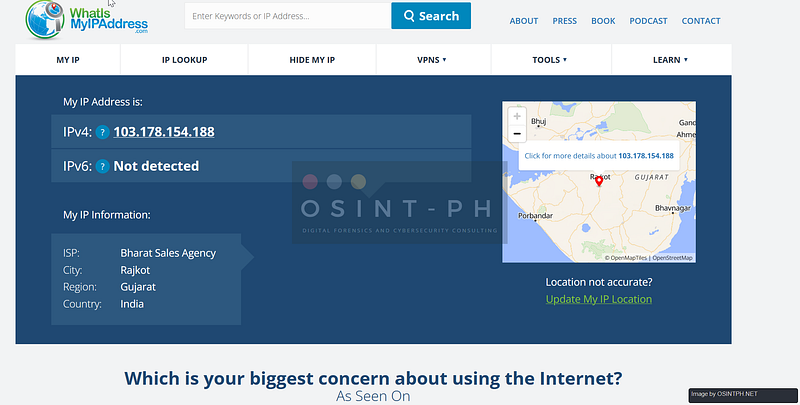
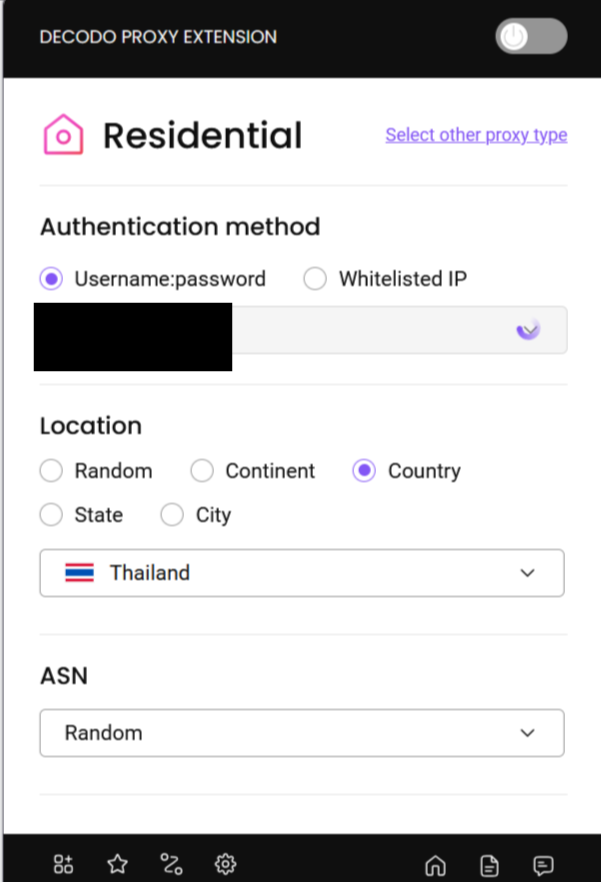
In this case, my setting was “Random”. Turn off the proxy, and try another setting here:
For example Thailand:
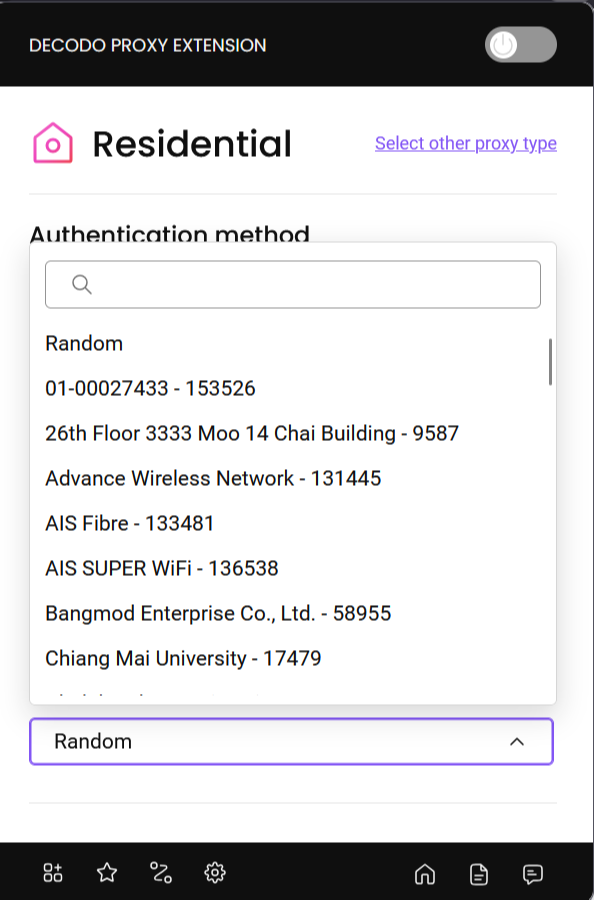
You can also chose the specific ASN if that is what you want to do:
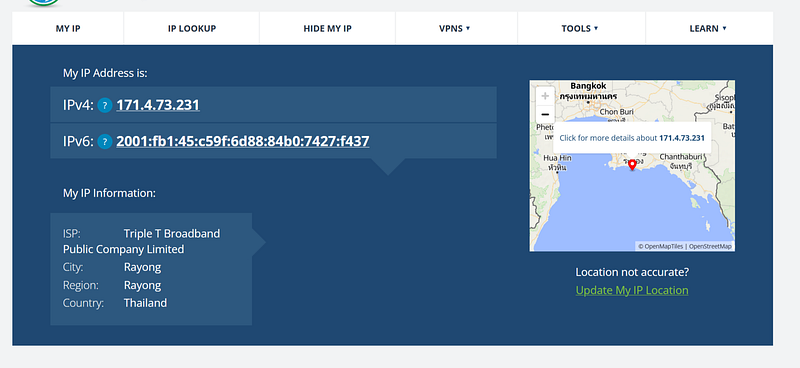
Turn it on again and validate:
Keep Track of your usage in Decodo, in the Dashboard:
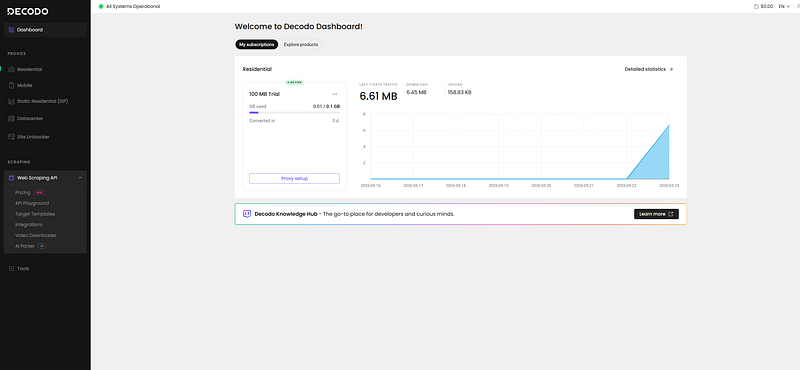
Installed in a hardened OSINT browser profile (preferably one segregated from any personally identifying use), I use CSI Linux for day to day work, the extension exposes proxy controls directly in the toolbar:
- Dynamic location switching. A dropdown lets you swap your apparent country, city, or even ASN with a single click. Investigating a Brazilian crypto scam? Switch to São Paulo residential. Need to verify whether a phishing page geo-fences to Germany? One click to a Berlin IP. The friction drops to near zero.
- IP rotation on demand. Burned an IP because the target site challenged you? Click to rotate. Need a fresh identity per tab? Configurable.
- Sticky vs. rotating session toggle. For workflows where the same site needs to see a consistent IP across multiple page loads (e.g., logging into a research sock-puppet account), sticky mode is one toggle away. For broad reconnaissance where every page load should look like a different user, rotating mode is the default.
- No system-level configuration. Crucially, the extension proxies only the Firefox traffic of that profile, your operating system traffic, your other browsers, your background processes all continue to egress normally. This isolation is good OPSEC hygiene; it prevents the kind of accidental leak that happens when a system-wide VPN drops and a Slack ping suddenly outs your real IP.
The practical effect for an investigator is profound. You’re studying a counterfeit goods marketplace? Browse it from a residential IP in the seller’s claimed shipping country. You’re chasing a phishing campaign? Visit the landing page from an IP that geolocates to the victim demographic. You’re profiling a threat actor’s online footprint? Visit each of their linked properties from a different residential IP so that even a paranoid operator running their own visitor analytics sees nothing connecting the visits.
All of this happens live, in a normal browsing session, with no scripts, no terminal, no infrastructure overhead. That accessibility is exactly what makes residential proxies usable for the kinds of investigators, journalists, fraud analysts, brand teams, who aren’t necessarily security engineers.
6. Conclusion: Automation and Stealth, Working in Tandem
The modern OSINT workflow is bimodal. There is automated collection, the always-on pipelines that ingest forum posts, marketplace listings, social media graphs, and breach data at industrial scale. And there is manual investigation, the human analyst clicking through a lead, reading a thread, watching a profile, pivoting on a name.
Both modes share the same OPSEC requirement: the target must not know you exist. And both modes are defeated by the same infrastructure failure: visible, attributable, low-reputation IP egress.
Residential proxies solve that failure mode comprehensively. By routing traffic through real consumer connections, they let automated pipelines collect clean, unpoisoned data at scale, and they let human investigators browse hostile properties live without leaving a forensic trail. Providers like Decodo, with their large ethically sourced pools, granular targeting, and dual API/extension delivery, make both modes accessible without forcing analysts to choose between scale and stealth.
For any investigator serious about the integrity of their findings, and the safety of their organization, residential proxy infrastructure has moved from “advanced tradecraft” to baseline professional hygiene. The targets have professionalized their defenses. So must we.
OSINT investigations should always be conducted within applicable legal and ethical frameworks, including terms of service, data protection laws, and any sector-specific regulations governing the investigator’s organization.
Alternative Providers Worth Shortlisting
Decodo is not the only credible player in this space. The residential proxy market in 2026 is mature, competitive, and stratified, different providers serve different buyer profiles, and the right choice for any given investigator depends on scale, technical depth, ethical posture, and budget. Below are the names worth shortlisting if Decodo doesn’t fit your workflow, grouped by tier.
Enterprise tier (large pools, deep targeting, premium pricing):
- Bright Data: The market incumbent, with a residential network of over 400M IPs across 195 countries and an unusually deep product surface that extends well beyond raw proxies into Web Unlocker, Scraping Browser, SERP APIs, and downloadable datasets. Customers include Microsoft, Statista, McDonald’s, and EPSON among others. The most powerful option, priced accordingly. Best suited to corporate intelligence teams and large threat research programs with the budget and headcount to use the platform’s full capabilities.
- Oxylabs: The other heavyweight, with 175M+ IPs and tiered pricing in the $2.50–$6/GB range. Independently measured among the fastest in the market with sub-0.6s response times on residential, and EU-headquartered with strong compliance documentation, relevant for European investigators with regulatory exposure. Their AI-assisted proxy management offers adaptive rotation strategies, useful for teams that don’t want to hand-tune session logic.
Mid-market (solid feature depth, more accessible pricing):
- NetNut: Differentiates by sourcing IPs through direct ISP partnerships rather than P2P networks, which can mean cleaner IPs but potentially smaller effective pools. Strong for account-bound investigative work where session stability matters more than pool size, sock-puppet management, longitudinal target monitoring, anything requiring long sticky sessions.
- SOAX: Pool of over 155 million residential IP addresses with a reputation for clean proxies and minimal blacklisting issues. A good choice when precision matters more than raw scale — localized threat intelligence, regional ad verification, geo-fenced content investigation.
- IPRoyal: Popular with researchers and smaller data teams. Pay-as-you-go pricing from $1.75/GB with non-expiring traffic (bandwidth doesn’t burn on a clock), which makes it economical for occasional or bursty investigative workloads rather than always-on pipelines.
Budget tier and developer-friendly:
- Webshare: Known for simple and accessible proxy infrastructure, particularly among developers and automation teams, with straightforward pricing popular for scraping scripts and automation workflows. A reasonable starting point for someone newer to the space, less suited to large sustained investigations.
- DataImpulse: More than 90 million ethically sourced residential IPs across 195 countries, priced at $1 per GB, with rollover of unused GBs and no subscription lock-ins. Very budget-friendly; lacks some of the advanced session and targeting features of premium providers, but adequate for many OSINT use cases.
- Rayobyte (formerly Blazing SEO): A US-based provider focused on high-volume scraping performance, unlimited sessions, and low-latency routing across globally distributed residential IP pools. Strong for analysts doing large-batch collection where session count matters more than ZIP-level targeting precision.
- ProxyEmpire: Flexible pricing and session control, including pay-as-you-go bandwidth, sticky sessions, and non-expiring traffic models. A practical middle ground between the budget tier and the mid-market, often selected by independent researchers and small consultancies.
A note on selection. Pool size is the most-marketed number and the least useful single metric. What actually matters for OSINT work is, in rough order: the freshness and rotation rate of the pool, granularity of targeting (country-only is rarely enough, city, ZIP, and ASN matter), session control depth (sticky-session length for account-bound work), ethical sourcing transparency (which matters both ethically and for evidentiary chain-of-custody in legal proceedings), and the provider’s posture toward sensitive research use cases. Most credible providers offer free trials or low-commitment entry plans. Use them to test against your actual target sites before signing anything substantial.
Reach out if you have questions or comments or what to collaborate
Session Messenger: 059db238ab37c3d92615c5cc24b694da29c598cc13e27886053722404118e14271